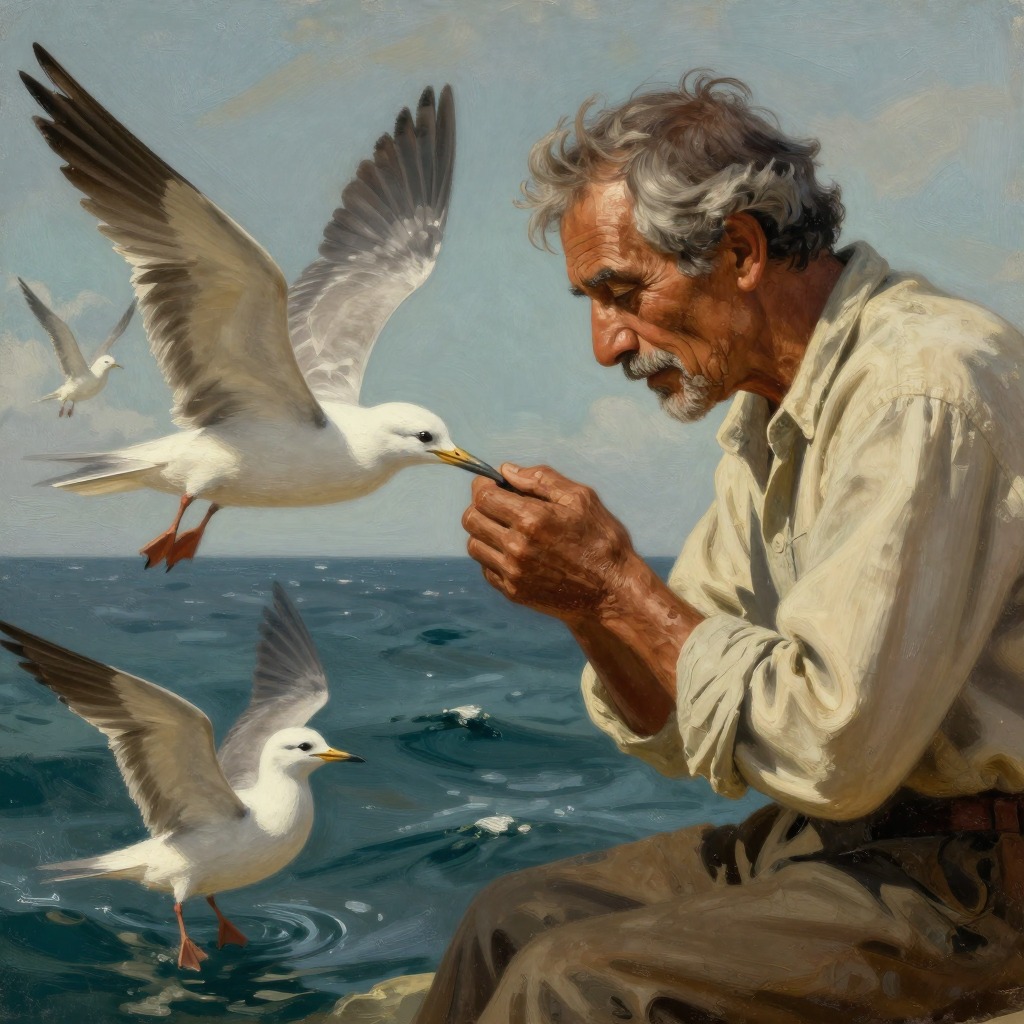
the warbler
The warbler is a small, exhausted bird that appears only once in The Old Man and the Sea, during the second day of Santiago's battle with the great marlin. Its brief visit, lasting no more than a few minutes, provides a moment of tender respite in the narrative and deepens the reader's understanding of Santiago's character and his relationship with the natural world.
Appearance and Encounter
The warbler arrives from the north, flying very low over the water, and Santiago can see immediately that it is very tired. The bird first lands on the stern of the skiff for a rest, then flies around the old man's head before settling on the fishing line, where it is more comfortable. Santiago speaks to the bird directly, asking, "How old are you?" and "Is this your first trip?" The bird is too exhausted even to examine the line, teetering on it as its delicate feet grip fast. Santiago reassures the bird that the line is steady, though he reflects that it is "too steady" and that the bird should not be so tired after a windless night. He thinks of the hawks that come out to sea to meet such birds but says nothing of this to the warbler, knowing it cannot understand him and will learn about the hawks soon enough.
Santiago's Compassion and the Context of the Struggle
Santiago's interaction with the warbler reveals his deep empathy for all creatures, even as he is locked in a life-or-death struggle with the marlin. He encourages the bird to rest, saying, "Take a good rest, small bird. Then go in and take your chance like any man or bird or fish." He even offers the bird shelter at his house, apologizing that he cannot hoist the sail to take it in because he is "with a friend"—referring to the marlin he is fighting. This moment of gentle concern contrasts sharply with the violence of his ongoing battle. The warbler's presence also provides Santiago with a welcome distraction from his own physical suffering; his back has stiffened in the night and hurts truly, and talking to the bird encourages him. However, the encounter is abruptly cut short when the marlin gives a sudden lurch, pulling Santiago down onto the bow and nearly throwing him overboard. The bird flies up when the line jerks, and Santiago does not even see it go. He later looks around for the bird, wishing for its company, but it is gone. He reflects that the bird did not stay long and that the journey ahead will be rougher until it makes the shore.
Thematic Significance
The warbler functions as a powerful symbol of vulnerability and the precariousness of life in the natural world. Like the flying fish, the porpoises, and the marlin itself, the warbler is a fellow creature navigating a vast and often hostile environment. Santiago's instinct to protect and comfort the bird, even as he is being towed by a fish that may kill him, underscores his profound sense of kinship with all living things. The bird's exhaustion and its need to rest on the line—the very instrument of Santiago's struggle—creates a fleeting but potent image of shared fragility. The warbler's departure, driven by the marlin's sudden movement, also foreshadows the relentless and unforgiving nature of the sea, where moments of tenderness are always subject to interruption by the harsh realities of survival. The bird is never seen again, its fate left unknown, a small, unresolved note in the larger symphony of the old man's ordeal.